The First Dream: the Birth of Jesus
Being a man led by God, St. Joseph always sought after God’s guidance, which was offered to him through four dreams.
Then Joseph her husband, being a just man, and not wanting to make her a public example, was minded to put her away secretly. But while he thought about this these things, behold, an angel of the Lord appeared to him in a dream, saying: ‘Joseph, son of David, do not be afraid to take to you Mary your wife, for that which is conceived in her is of the Holy Spirit. And she will bring forth a Son, and you shall call His name Jesus, for He will save His people from their sins.’ So all this was done that it might be fulfilled which was spoken by the Lord through the prophet, saying: ‘Behold, the virgin shall be with child, and bear a Son, and they shall call His name Immanuel,’ which is translated, “God with us.” Then Joseph, being aroused from sleep, did as the angel of the Lord commanded him and took to him his wife, and did not know her till she had brought forth her firstborn Son. And he called His name Jesus.
(Matthew 1:19-25)
The Second Dream: the Flight to Egypt
After the visit of the wise men, an angel of the Lord appeared to Joseph in a dream saying::
Arise, take the young Child and His mother, flee to Egypt, and stay there until I bring you word; for Herod will seek the young Child to destroy Him. When he arose, he took the young Child and His mother by night and departed for Egypt
(Matthew 2:13-14)
The Third Dream: Return to Israel
“Now when Herod was dead, behold, an angel of the Lord appeared in a dream to Joseph in Egypt, saying, ‘Arise, take the young Child and His mother, and go to the land of Israel, for those who sought the young Child’s life are dead.’ Then he arose, took the young Child and His mother, and came into the land of Israel.”
(Matthew 2:19-21)
The Fourth Dream: Going to Nazareth
“But when he heard that Archelaus was reigning over Judea instead of his father Herod, he was afraid to go there. And being warned by God in a dream, he turned aside into the region of Galilee. And he came and dwelt in a city called Nazareth, that it might be fulfilled which was spoken by the prophets, ‘He shall be called a Nazarene.’ “
(Matthew 2:22-23)
His Departure
Having lived a life led by unwavering trust in the Lord’s words,
“I am the Lord your God, Who teaches you to profit, Who leads you by the way you should go.”
(Isaiah 48:17)
The righteous St. Joseph departed in the sixteenth year of the advent of the Lord Christ, Who was present at his departure. The Lord Christ laid His hand upon Saint Joseph’s eyes, extended his arms, and delivered up his soul. Saint Joseph was buried in the tomb of his father Jacob. All the days of his life were one hundred and eleven years.
His Feast
The church celebrates the commemoration of the Upright St. Joseph on August 2nd every year – the 26th day of the Coptic month of Abib.
Learn more about St. Joseph’s story by Clicking Here!
Source: St. Mary & St. Joseph COC, ON
During the holy days of the Nativity Fast, as we prepare ourselves to receive the Word Incarnate, we tend to focus on the Baby Jesus and His blessed mother Virgin Mary. We sing praises to our Lord Jesus Christ and we venerate St. Mary as we chant the Kioahk Praises.
In the churches, replicas of mangers are up and the icons of the Nativity and the Holy Family take center places. In all this festivity, we tend to overlook the role of a very important member of the Holy Family during these events, St. Joseph the carpenter.
Born in Bethlehem of Judea, St. Joseph came from the royal lineage of King David. Both St. Luke and St. Matthew mark his descent from David, the greatest king of Israel (Matthew 1:1-16 and Luke 3:23-38). The Scriptures do not tell us why or when originally St. Joseph left Bethlehem and chose Nazareth to be his place of residence, but it tells us that he was a carpenter (Matthew 13:55).
According to tradition, when St. Mary, who was dedicated to the temple, completed twelve years in the sanctuary and could not stay there any longer, the priests announced through Judea that they wished to find in the tribe of Judah a respectable man, to espouse her. St. Joseph was among the candidates. A miracle revealed the choice of St. Joseph God had made. When the priests gathered twelve righteous men from the tribe of Judah and took their staffs inside the sanctuary, a dove flew up and stood on the staff belonging to St. Joseph. They immediately knew that this was God’s will. The righteous St. Joseph took St. Mary to his house. Both spouses intended for this betrothal to be virginal marriage.
When St. Joseph discovered St. Mary was pregnant, he knew the child was not his. St. Joseph knew that a woman accused of adultery could be stoned to death. Being a compassionate man, full of love he did not want to defame her for "Love covers all sins" (Proverbs 10:12). Being sensible and discreet he did not show annoyance nor behaved in anger but behaved with prudence "A fool’s wrath is known at once, But a prudent man covers shame" (Proverbs 12:16) and decided to put her away secretly (Matthew 1:18,19).
"But while he thought about these things, behold, an angel of the Lord appeared to him in a dream, saying, "Joseph, son of David, do not be afraid to take to you Mary your wife, for that which is conceived in her is of the Holy Spirit..." Then Joseph, being aroused from sleep, did as the angel of the Lord commanded him and took to him his wife." (Matthew 1:20-24) St. Joseph did not doubt the angel of the Lord but in full faith accepted his words and kept St. Mary with him.
A few months later, Caesar Augustus issued a decree ordering the entire world to be registered everyone in his own city. For St. Joseph and St. Mary, this meant to travel from Nazareth of Galilee to Bethlehem of Judea. Upon their arrival in Bethlehem "the days were completed for her to be delivered ...." and "there was no room for them in the inn" (Luke 2:1-7). St. Joseph was there with St. Mary at the birth of our Lord. He was there when the shepherds came to greet the Newborn. He witnessed the wise men offering gifts to the Child. He took full responsibility of the Mother and Child.
St. Joseph was a modest man not with great means for when the time came to present the Child Jesus to the Temple to be circumcised he offered the sacrifice of two turtledoves or a pair of pigeons, allowed only for those who could not afford a lamb (Luke 2:24). He was present at the temple, saw Simeon the elder carry the Child and prophesy about Him. Both St. Joseph and St. Mary marveled at those things spoken of the Lord and they both received Simeon blessings.
St. Joseph was man of faith, obedient to God in everyway. When the angel of the Lord appeared to him and told him "Arise, take the young Child and His mother, flee to Egypt, and stay there until I bring you word; for Herod will seek the young Child to destroy Him" (Matthew 2:13). He did not hesitate but immediately left everything he owned, all his relatives and friends, and fled to Egypt, a strange country. He took full responsibility of the Child although he is not His real father. It did not occur to him that his own life and the life of St. Mary were not in danger, but only the Child. He could have resented this move but he did not. In all obedience he went to Egypt and waited there submissively until the angel of the Lord told him it was safe to go back (Matthew 2:13-23).
Upon their return from Egypt, the Holy Family settled again at Nazareth. St. Joseph supported himself and his family by his work. We do not know many details about their life in Nazareth except that they faithfully followed the religious practices commanded by the Law. Being a pious man St. Joseph traveled with his family each year to Jerusalem to observe the Passover, "His parents went to Jerusalem every year at the Feast of the Passover" (Luke 2:41).
St. Joseph raised the Lord Jesus, loved Him and cared for His safety. St. Matthew records an incident that took place when our Lord Jesus Christ was twelve years old. On their way home to Nazareth after celebrating the Passover in Jerusalem, St. Joseph and St. Mary discovered the absence of the Lord Jesus from among the company. Anxious for His safety they immediately returned to Jerusalem to look for Him. Three days had passed until they found Him sitting among the teachers at the temple listening to them and asking them questions. St. Joseph definitely treated the Lord Jesus as his own son; For the people of Nazareth had said of the Lord, "Is this not the son of Joseph" (Luke 4:22).
This incident of the Passover is the last account mentioning St. Joseph in the Holy Gospels. Tradition tells us that St. Joseph had died before Jesus entered public ministry. Our Lord was about sixteen years of age when His foster father St. Joseph departed. The Lord Christ was present at his departure, and laid His hand upon his eyes. St. Joseph extended his arms and delivered up his soul. He was buried in the tomb of his father Jacob. All the days of his life were one hundred and eleven years. His departure was on the twenty-sixth day of the month of Epep.
May the blessings of the righteous saint be with us all Amen.
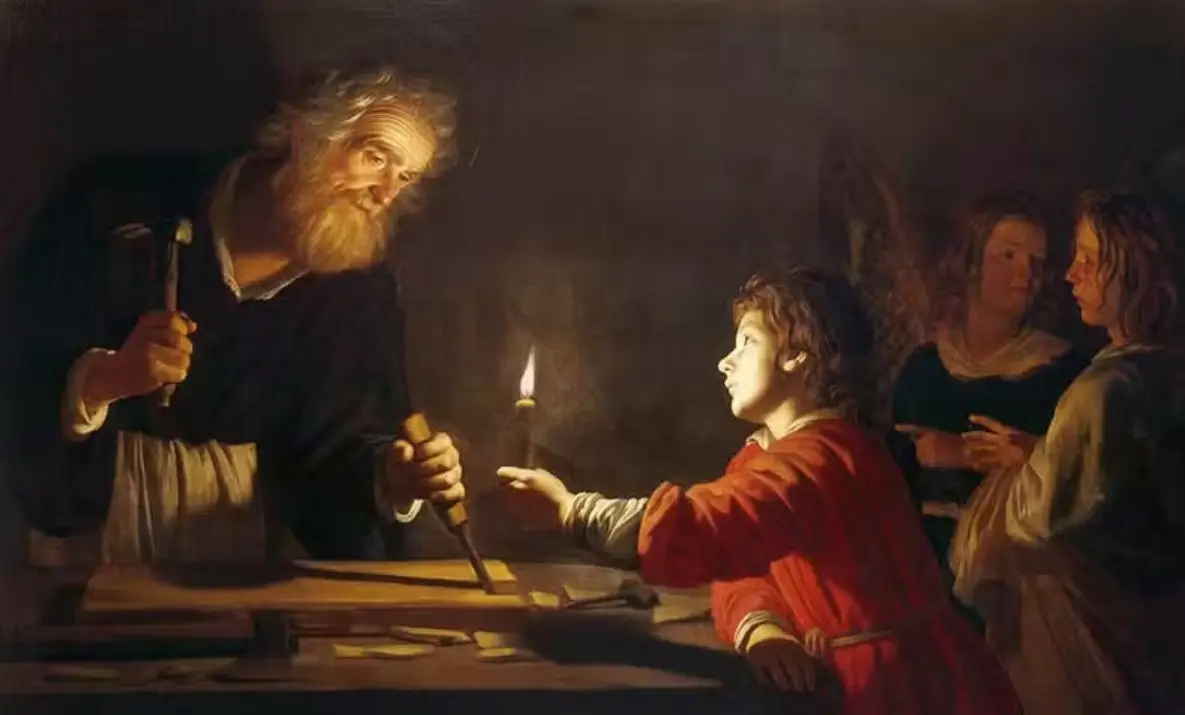 Source: St. Takla
Saint Joseph, the husband of Mary, the earthly father of Jesus. The common people around Nazareth identified Jesus as “the son of Joseph” (Luke 4:22; John 1:45; and 6:42). Twice Jesus is referred to as “the carpenter’s son” (Matthew 13:55; Mark 6:3). The work of a carpenter differed somewhat from that of carpenters in the twenty-first century. Israeli houses were built mostly of stone and earth. Joseph was an artificer in wood, and most likely worked with furniture and with agricultural implements.
Our study is taken primarily from the first chapter of Matthew and the second chapter of Luke. Matthew 1:1-17 gives the human ancestry of Jesus. Sometimes we are tempted to pass over the long list of names rather quickly, yet these verses are included in the Bible for a purpose. We can tell from the account in Matthew that Jesus was descended from Abraham (1:2) through the royal house of David (1:6). This information helps identify Jesus as the true Messiah, and makes Him the legal son of one who had descended from the line of Israel’s kings, and thus Jesus was eligible to be King over Israel.
The words in Matthew 1:16 make it clear that the conception and birth of Jesus were different from that of any other Jewish boy named in the genealogy. Joseph did not “beget” Jesus, as was the case in the 40-some ancestors of Jesus who are named in the earlier part of Matthew 1. Matthew does not say that Joseph “begot” Jesus; instead, Matthew says, “Joseph (was) the husband of Mary, of whom was born Jesus” (Matthew 1:16).
Joseph was not the human progenitor of Jesus. Luke’s account explains that by a miracle of the Holy Spirit, Jesus was conceived in the womb of the Virgin Mary (Luke 1:26-38). We don’t understand how the Holy Spirit could usher the life of the eternal Christ into the body of Mary, but with chaste language, Matthew explains more about the events that took place.
There are six major parts in this lesson:
-
Joseph: An upright man (Matthew 1:18-19)
-
Joseph: A considerate husband (Matthew 1:20-23)
-
Joseph: An obedient servant of God (Matthew 1:24-25)
-
Joseph: A good citizen of his country (Luke 2:1-5)
-
Joseph: A protector of his family (Matthew 2:13-23)
-
Joseph: A concerned father (Luke 2:41-50)
-
Joseph was an upright man (Matthew 1:18-19)
Joseph sometimes seems to be an almost forgotten man at Christmas time. The carols that mention Joseph are not really too plentiful.
We sing about “the virgin, the mother and child;” about “angels from the realms of glory;” about “shepherds in the fields abiding;” about “the town (named) Bethlehem;” about “the kings from the Orient;” and sometimes about Joseph, but not as much is said about Joseph.
True—the fact that Joseph was the foster father (and not the real biological ancestor of Jesus)—may reduce his stature in the eyes of some. And the fact that he never uttered a word which is recorded—may cause him to fade into the background. We have no record of any words that Joseph ever spoke, but we can be certain that God carefully examined the character of the man who was chosen to become the foster father of Jesus, and that God providentially supervised the choice of a husband for Mary.
Mary and Joseph both lived in the same town. They were brought up in the same community. When we compare Luke 1:26 with Luke 2:4, we learn that both lived in Nazareth. Joseph had likely been born in Bethlehem (65 miles to the south). But his family moved to Nazareth some time during his youth, and there he met Mary, and now they were a young couple engaged to be married.
Engagement in those days was a binding contract. It was nearly as binding as marriage is in our day. That is why Joseph is called Mary’s “husband” (and Mary is called his “wife”), even before their marriage was consummated (Matthew 1:19-20). An engagement was so binding that it could only be dissolved by divorce. And so these two young people were engaged to be married—when one day suddenly an angel told Mary that she was to have a child, not by normal human generation, but by the overwhelming of the Holy Spirit. Mary was looking forward to her wedding day. What would Joseph say when she broke the news that she was expecting a child? Joseph didn’t know anything about it. Even though they were engaged to be married, there was no dabbling with premarital sex.
-
Joseph was a considerate husband (Matthew 1:20-23)
The first three months following the angel’s announcement to Mary were spent at Elizabeth’s house. Elizabeth lived far away in the hill country of Judea. Mary remained with Elizabeth about three months and then returned to her home. When Mary came back to Nazareth, and had to tell Joseph of her condition, it must have filled him with some strange feelings.
Put yourself in Joseph’s place. He thought that Mary had always told the truth. Her previous character had always been blameless. But now her story seemed unreal and strange. Joseph wondered whether she may have been unfaithful during those three months in the hill country with Elizabeth. He was sure that she had not been, yet the conflict raged on in his soul, and probably the normal thing to do would have been to expose her and make her a public disgrace. And Joseph considered doing that very thing, but his love and compassion for Mary would not permit that kind of severe treatment. Matthew 1:19-20 says that Joseph was a righteous man, and while he was pondering what he ought to do, an angel of the Lord appeared to Joseph in a dream, and explained how Mary’s being with child came about.
Joseph could have been very cruel toward Mary. He could have stoned her, or divorced her—but he was a man of compassion and kindness, and he did not take those actions. If Mary had been espoused to a cruel, passionate man, she would have died in disgrace. But Joseph was a man of godly wisdom. He thought before he acted. He dealt thoughtfully and gracefully with Mary and treated her with courtesy. And that’s the way every husband should treat his wife. It is easy to forget this and take things for granted when we are occupied with earning a living for the family, and facing stiff competition in business—but a husband can never be too understanding of his wife’s concerns and problems.
Several decades ago there was an older man whose wife had become seriously ill with cancer. He took a leave of absence from his work in order to care for his sick wife. He never left her, except for short intervals to pick up groceries or get a haircut, etc. He treated her with utmost tenderness. When others would visit in their home, they could sometimes hear him say to his wife, whose body was wasting away rapidly, “Mother, you’re still my sweetheart.” That is the kind of spirit that should prevail in every home.
Sometimes husbands are short and snappy and quick with their speech. They speak with an irritated tone of voice. The husband must remember to speak with kindness and patience to his wife. After all, she left the love and security of her family and home to come and live with you; she took your name; she agreed to spend the rest of her life with you. It is the height of cruelty to speak to one’s wife with an irritated tone of voice.
Joseph was a righteous man. His life was marked by godly conduct. He was a considerate husband. We can learn from his example.
-
Joseph was an obedient servant of God (Matthew 1:24-25)
Joseph was willing at every turn to do God’s bidding. He was obedient when the angel explained to him how Mary had come to be with child. Joseph was minded to put her away, but Matthew 1:24-25 says that after the angel had spoken to him, Joseph awoke from his sleep, and did as the angel of the Lord commanded him. He took Mary as his wife, but had no marital relations with her until she had borne a son, “and he called his name Jesus.” Joseph did precisely as the angel had instructed.
Joseph did not understand the how and the why of this whole thing, but he acted in simple faith on the word of God’s messenger. He believed that the word from God was true, and he complied with what God had said. Joseph obeyed the Lord. He was an obedient servant of God. We should also be willing to obey the teachings of the New Testament even though we may not always know the reasons why God issues certain commands.
We must remember that our faith in Christ becomes a real faith (a saving faith) only when it is validated by obedience. It is not merely he who attends church services each Sunday and says “Lord, Lord,” that shall enter the kingdom of heaven, but he who does the will of the heavenly Father (Matthew 7:21). All of us need a frame of mind that is set to do the will of God, and that is determined to carry out the instructions of the Scriptures.
When Joseph awakened from his dream and knew that Mary was expecting the child as a result of a divine miracle, he hurried off to Mary’s house, and shortly thereafter they were married (as the Lord had told him to do)—and Joseph gave Mary the protection of a husband, and he gave the child the dignity of a foster father. Joseph was an obedient servant of God.
-
Joseph was a good citizen of his country (Luke 2:1-5)
The first five verses of the second chapter of Luke explain an important aspect of Joseph’s life. Joseph was submissive to Caesar Augustus (the Roman Emperor), who had decreed that a census should be taken. The word “taxed” (in the KJV) refers really to a “registration”—a compiling of information which later could be used for the purposes of taxation. But Joseph was obedient to the law of the land. He returned to his native town, as he was expected to do, and did as the authorities said that he should.
Joseph was not one who took the attitude that if a certain law (such as the wearing of seat belts) did not suit him, he was not going to obey it. Joseph was a law-abiding citizen of his country. When Caesar Augustus called for a census, Joseph dropped the work that he was doing and took his family to Bethlehem to be registered. But to take that step of obedience was not an easy task in Israel in New Testament times.
The Romans controlled the country of Israel, and many Jews all over the land resented the idea of Roman control. They despised the idea of more taxation. They planned to resist with violence. The Jewish historian Josephus tells how the Zealots (political extremists) made life hard for the people who did go to their home towns and register. The Zealots often plundered their property and drove away their cattle and set fire to their houses while they were gone. But Joseph was an obedient servant of God, and this involves being a good citizen of the land.
God’s people should be good citizens and obey the laws, unless those laws conflict with the clear teachings of the New Testament.
-
Joseph was a protector of his family (Matthew 2:13-23)
When Herod pretended that he wanted to worship the newborn Baby in Bethlehem, God warned Joseph in a dream to take the Child and Mary, and flee to Egypt.
Under the cover of darkness (Matthew 2:14), they departed “by night.” Perhaps the moon was bright and thus helped to make the travel easier. At any rate, Joseph obeyed the Lord, and took his family, and left Bethlehem. They journeyed south to Egypt.
Colonies of Jews lived in most cities of Egypt, and thus Joseph and Mary could find associations among their own people when once they were down in Egypt. But did you ever try to picture what the trip from Bethlehem to Egypt really involved?
The journey involved traveling more than 150 miles across a desert. It was blistering hot by day and chilling cold by night. The area was infested with robbers and bandits. Joseph and Mary traveled mainly by foot. Mary likely rode a donkey at times. There were no sanitation facilities, and the land-surface was marked by high hills and deep valleys and steep cliffs. It was a dangerous journey (Matthew 2:14).
Suppose the donkey would have stumbled on a rocky path at the crest of a ridge, and spilled Mary and the Child onto the rocks below! Or suppose sickness would have engulfed the Child, and the extremes of temperature would have brought Him to the point of death. Or suppose Herod’s executioners would have overtaken Joseph and Mary, and extinguished the Child’s life. God’s plan to save the human family through the gift of His Son would have failed. God used Joseph to protect the little family from unseen harm, and from dangerous attack.
After a stay in Egypt, Matthew 2:22 tells about the return of the family to the land of Israel. Herod had died, and because Herod’s son was ruling over Judea, Joseph chose to take the family north to Galilee and settle in their home town of Nazareth. Joseph and Mary and Jesus made their home in the town of Nazareth.
-
Joseph was a concerned father (Luke 2:41-50)
Jesus went to the temple with Joseph and Mary for the first time (after His circumcision) when He was twelve years old. They attended the Passover festival in Jerusalem—and when the events were completed, the caravan of people began moving toward their homes in the towns and the countryside. At one point in the journey, Joseph and Mary discovered that Jesus was missing.
Joseph is sometimes accused of careless neglect, but there is no indication of neglect or carelessness on the part of either Joseph or Mary. It was a common practice for families to travel together, and the families were so well acquainted that the children of one family were like the children of another. The families were so preoccupied with what they had heard in the Temple, and with the joys of returning home again—that they had not discovered immediately that Jesus was missing.
When it was learned that Jesus was not with the group, Joseph and Mary retraced their steps and returned to Jerusalem and found Jesus talking with the learned scribes in the Temple. Their surprise (at what seems like a thoughtless act on the part of Jesus) teaches us two lessons:
-
It shows how obedient to His parents Jesus had previously been. He had been so obedient and so loyal in the days of childhood that Joseph and Mary had confidence in His dependability. They were startled and confused on this occasion when He was not with them.
-
It proves that the childhood of Jesus had been normal and natural—and not marked by certain supernatural abilities such as those described in some of the Apocryphal writings. Those books tell some strange things about Jesus—for example, a teacher was about to whip Him with a paddle, but the paddle turned into a serpent.
This account at the end of the second chapter of Luke is the last recorded event that involves Joseph. He is not mentioned there by name, but Mary told Jesus that she and His father had been looking for Him anxiously (Luke 2:48).
We need to honor Joseph because he was a righteous man, a considerate husband, an obedient servant, a good citizen, a protector of his family, and a concerned father. These are goals which all of us should seek to embrace.
Source: Harold S. Martin - A Bible Helps
The Twenty-Sixth Day of the Blessed Month of Abib
On this day, the righteous man St. Joseph, the carpenter, who was worthy to be called the father of Christ in the flesh, departed at a good old age. The Holy Gospel bore witness that he was a righteous man, and God chose him to be betrothed to the all-pure, our lady, the Virgin St. Mary. When he finished his course, his strife, his toil in the journey together with the Lord and the Virgin Lady from Bethlehem to the land of Egypt, and the tribulations that befell him from the Jews, he departed in peace.
When the time came for him to depart from this world to the world of the living, the Lord Christ was present at his departure and laid His hand upon his eyes. He extended his arms, delivered up his soul, and was buried in the tomb of his father Jacob. All the days of his life were one hundred and eleven years; forty years before his marriage, fifty-two years married, and nineteen years a widow. His departure was in the sixteenth year of the advent of the Lord Christ.
May his prayers be with us. Amen.
Source: St. Takla